

You’re ready to leave your business. But is it ready for you to go?
For owners who’ve spent years building a company, deciding to leave can feel like the final step. Yet it’s more likely the start of a process they haven’t allowed enough time for.
At our latest Referrer’s Lunch, we explored what that process involves with Simon Bedard, Managing Director of Exit Advisory Group, National Chairman of the Australian Institute of Business Brokers and author of Exit Like an Expert. Simon has started, bought and exited businesses himself, and helps other owners grow company value and exit on their own terms.
What is the succession cliff?
The succession cliff is the wave of business owners approaching retirement, creating a widespread need to transfer ownership and leadership.
Simon estimates around a million Australian businesses could change hands or close over the next decade. Without succession plans, viable businesses risk closing when their owners leave.
Ready to leave doesn’t mean ready to sell
Brett Bonser, align.me Co-Founder and Executive Director, framed the challenge facing owners preparing to sell – getting their businesses ready while navigating conditions outside their control. Global economic uncertainty and changes in tax law are complicating sales. The total value of announced M&A deals in Australia and New Zealand fell by a third in FY2026. (1)
But the preparation gap extends beyond selling. Many owners are approaching an exit without a plan:
- Nearly 1 in 3 Australian small business owners plan to retire within five years, yet only 16% have a documented succession plan. (2)
- 91% of SME owners looking to exit have no previous transition experience. (3)
- 61% of those intending to exit face difficulty getting a good price, finding a suitable buyer or identifying the right person to take over. (3)
For owners counting on their business to support their next stage of life, leaving these decisions unresolved can limit their choices about when and how they step back.
Owners see opportunity. Buyers price risk.
“Look at your business through the eyes of a buyer, and I guarantee you’ll start to see things a little bit differently,” said Simon.
That’s because owners see the opportunities ahead, the markets they could enter and the growth still to come. Buyers look in from the outside and ask what could go wrong once their money is invested.
What buyers assess
- Financial performance – the results and earnings behind the business
- People and leadership – the team that will keep it running
- Operating systems – how it plans, generates revenue and delivers for customers
For an owner, a useful test is to imagine buying their own business, knowing everything they know about it. What would they question or want resolved before committing their money?
Those answers provide a starting point for becoming sale-ready and sale-worthy.
How long does preparing for a business exit take?
Preparing for an exit can take several years, including time to improve the business, complete a transaction and hand over responsibilities. Simon illustrated a five-year journey for an owner planning to sell, while noting that individual timelines vary.
An owner may feel ready to leave today, only to discover that a buyer needs them to stay for two years after the transaction. Allow a year for the sale itself, and they could still have three years of work ahead of them.
That’s before accounting for the time it takes to increase the business’s value. Simon gave the example of an owner who needs $5 million from their business, only to find it’s currently worth closer to $3 million. Closing that gap means identifying what’s holding the value back and making improvements – work that needs to happen before the sale process begins.
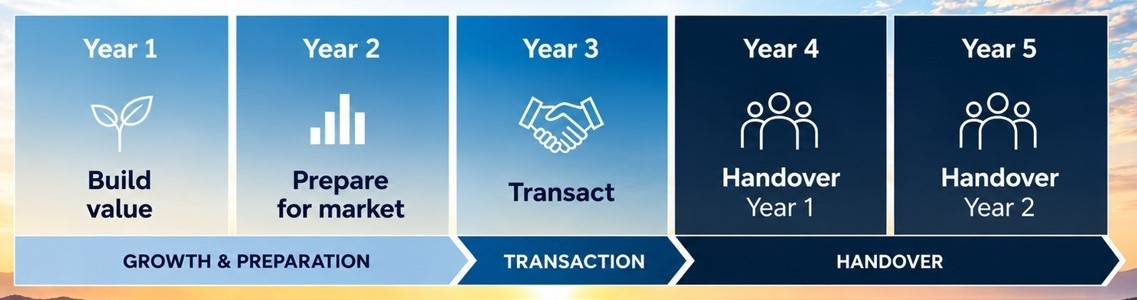
The timing will vary, but working backwards from when you want to be out means allowing for preparation and handover as well as the transaction.
For those who aren’t ready to choose a date, Simon suggested thinking of a business journey as a highway with planned exit ramps. A significant contract, an established general manager or a leadership team ready to take over could create a sensible opportunity to step back. Preparing for those milestones gives owners more choice.
What do you need from your exit?
Preparing your business is only part of an exit. You also need to consider what you want from life afterwards.
An exit doesn’t necessarily mean a sale. Stepping back from running a business and stepping out of its ownership are different decisions, and they don’t have to happen together.
Five factors that shape your exit
- Value: What is the business worth today, and what do you need it to be worth?
- Timing: How much longer do you want to work in it, and how much longer do you want to own it?
- Legacy: What matters to you about the future of your employees, customers, suppliers and family?
- Transition: What deal structure, payment terms and ongoing role would you accept?
- Readiness: Are you prepared for life after this business, including something purposeful to spend your time on?
These questions need agreement between business partners too. Different expectations about value, timing or what comes next can become difficult to reconcile once a transaction is underway.
Group discussions
The discussion then opened to the room. With owners, brokers and advisers taking part, the workshops drew on first-hand experience from both sides of a sale.
Reducing key person risk
A business that depends on one person presents a risk to its future owner. That dependence can also limit its ability to grow, whether a sale is on the horizon or not.
The first workshop explored how owners could reduce that risk. Four considerations emerged:
- Give others the authority to lead. A sound executive structure, clear delegation and awareness of plans help reduce reliance on the founder. The team needs the authority to act on those plans too.
- Prepare customer relationships for transition. If those relationships sit with the founder, how will they transfer to new leadership or ownership? Customer continuity needs to be considered alongside internal responsibilities.
- Build commitment beyond contracts. Appropriate agreements and incentives matter, but insurance and contracts don’t remove dependence on a key person. The discussion also highlighted the importance of identifying the likely acquirer, because strategic and private equity buyers may need different people and capabilities to remain after a sale.
- Test the owner’s readiness to let go. An owner can appoint a CEO, then find themselves taking control back. Preparing others to lead also requires the owner to be comfortable stepping aside.
These risks are connected. A leadership appointment alone won’t resolve them if customers still rely on the founder or the founder continues making every decision
What buyers look for beyond financial performance
The second workshop widened the assessment beyond key people. Guests were asked which metrics would matter when buying a business, with a particular focus on non-financial measures.
Their considerations covered five areas.
Revenue and growth
- A consistent growth trend
- Quality of revenue – whether it recurs or needs to be won each year again
- The pipeline, secured contracts, business plans and growth strategies
Customers and suppliers
- Long-term customer relationships
- Customer endorsements, particularly if a buyer intended to enter new markets
- Net Promoter Score (NPS)
- Dependence on individual customers or suppliers
People and management
- Staff retention, turnover and tenure
- Management quality and evidence of how well the business operates
- Interviews and presentations from key staff to assess alignment and potential flight risks
Technology and IP
- Technology and software readiness
- Security and intellectual property protection
Future risks and opportunities
- The industry’s future sustainability
- Opportunities in under-utilised assets
- Potential impacts of AI and a practical plan for responding
- Legal and reputational risks
Hugh Macfarlane, align.me founder and CEO, captured the contrast between the workshops with an observation – the groups had found “two things” to consider as sellers and “200” as buyers.
The first question focused on key person risk, while the second invited a broader assessment. That broader list gives owners a useful readiness test. Which questions could they answer confidently today, and which would expose work still to do?
How much do you tell your team?
The timing and extent of disclosure depend on the business, its size and the relationships involved. Selected managers may need to help prepare the transition or meet buyers, while wider disclosure can create uncertainty.
Guests shared different experiences of deciding who to involve and when. Lee Trevena favoured involving selected staff without broadcasting the sale. Howard Wigham noted that business size changes what’s practical, a substantial transaction requires a management team that knows what’s happening. Mic Pilon shared successful examples of both early disclosure and restricted communication, with the approach depending on the business, industry and relationships involved.
Simon described his usual approach as need-to-know. Even where an acquisition might create opportunities for employees, their reactions can be difficult to predict. Lee added that uncertainty becomes a transaction risk if it affects performance, while Simon raised the possibility of staff leaving during the sale.
These different experiences show why this decision warrants early thought. Owners need people to help make the transition work, but the timing and extent of disclosure depend on the circumstances.
Don’t assume someone will take over
Family and management can seem like natural successors, but neither is a certainty. Children may not want to follow their parents into the business. A capable management team may lack the capital to buy it – or have no desire to take on the owner’s responsibilities and financial risk.
Family and management succession can be viable options, but willingness and capacity need to be established. Leaving that conversation until you’re ready to go could mean discovering that your expected successor isn’t an option at all.
Final thoughts
Avoiding the succession cliff means preparing while you still have choices – about when to leave, how to leave and what comes next.
Developing leaders, transferring customer relationships and demonstrating reliable performance all take time. So does understanding what you need personally from the next stage of life.
You don’t need an exit date to start that work. But you should prepare while you still want to be there – so deciding to leave doesn’t mean discovering how much longer you have to stay.
Sources
(1) https://www.bcg.com/publications/2026/australia-nz-m-and-a-decade-low
(3) NAB, Your Next Step – A practical guide to help SMEs exit, or transition from their business, 2019